
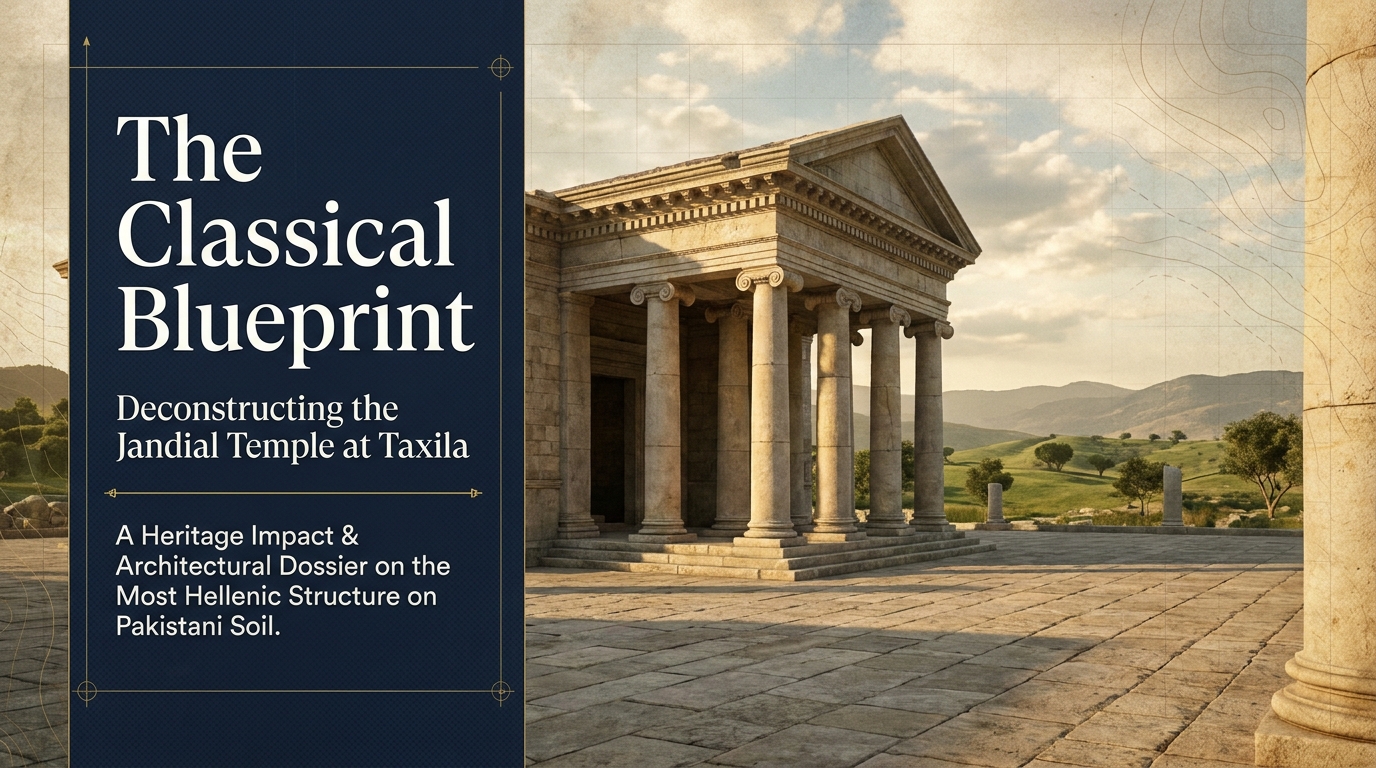
Banner photograph: Sirkap, Taxila — PWHI archive.
Update, 23 July 2026 — this is now a pattern
UNESCO is reported to have raised concerns over restoration works at a second Pakistani World Heritage property, Rohtas Fort (No. 586), following a visit on 21 July — again on the question of cement applied to historic masonry, again in Punjab, again under the same custodial department. → Rohtas Watch
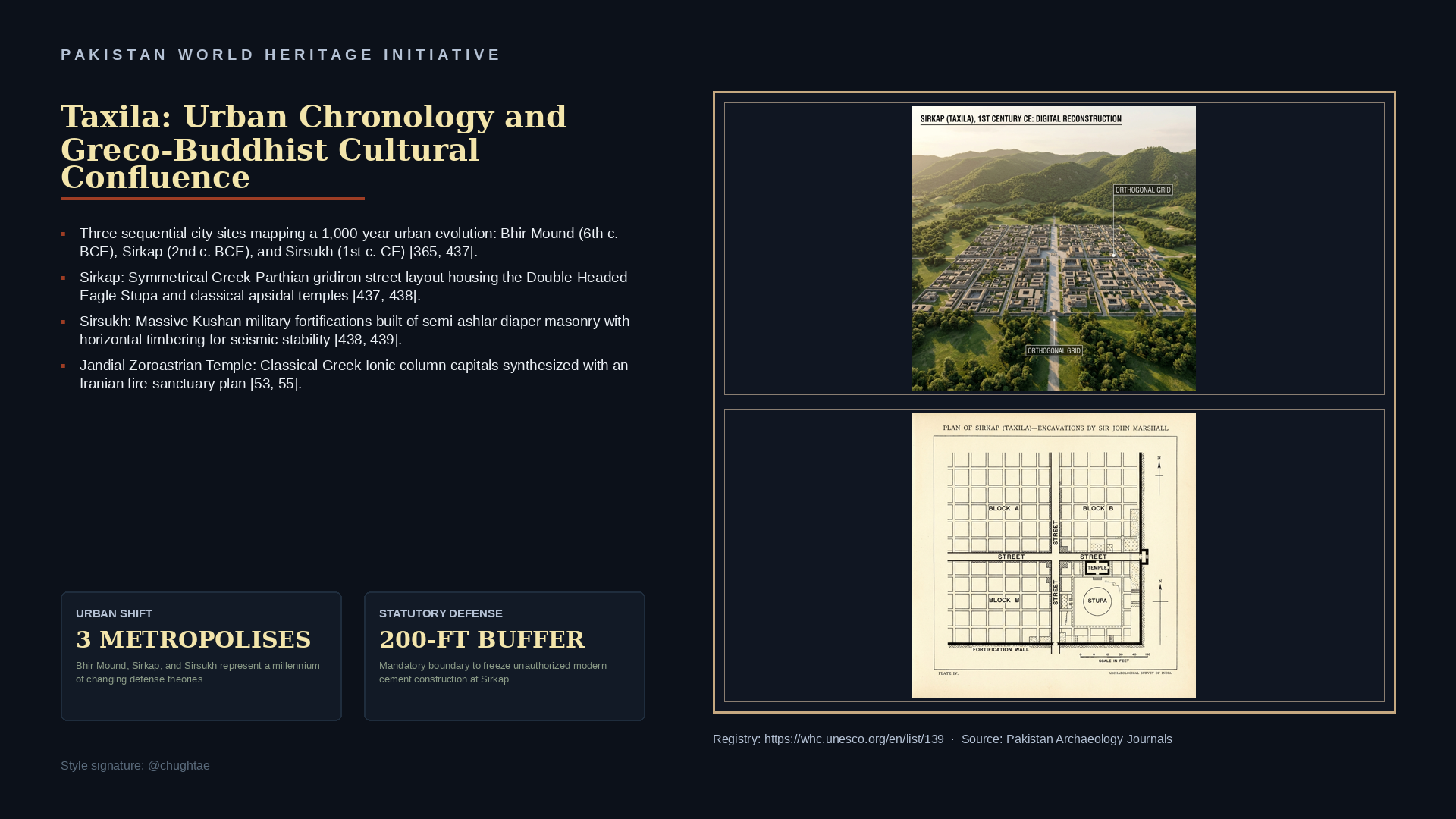
In early July 2026 the UNESCO World Heritage Centre conveyed formal concerns to Pakistan over conservation interventions at the Taxila World Heritage property — reported use of modern cement mortar and reconstruction of wall sections with new materials at the Mohra Moradu monastic complex and the Sirkap city remains. This page holds the complete public record.
Why the material matters
World Heritage status rests on authenticity and integrity — the original fabric, materials and craftsmanship that carry a site’s Outstanding Universal Value. Modern cement mortar is irreversible, chemically aggressive to ancient masonry, and visually falsifies the record. International practice distinguishes scientific conservation and anastylosis (reassembly of original elements) from reconstruction with new material — which the Operational Guidelines treat as justifiable only in exceptional circumstances, on complete and detailed documentation.

Timeline
1980
Taxila inscribed
Inscribed on the World Heritage List (property No. 139) — the Gandharan urban and monastic landscape: Bhir Mound, Sirkap, Sirsukh, Dharmarajika, Jaulian, Mohra Moradu and associated sites.
1999 – 2013
State of Conservation history
Repeated SOC reporting on Taxila: development pressure, quarrying vibration, management and buffer-zone weaknesses. The property has a documented monitoring record — this is not the first alarm.
2010
18th Amendment devolution
Archaeology devolves to the provinces; the federal National Heritage & Culture Division remains State Party to the Convention. The coordination seam this created is central to the present crisis.
2025 – 2026
Cement interventions at Mohra Moradu & Sirkap
Works undertaken under provincial conservation programmes reportedly apply modern cement mortar and rebuild wall sections with new materials on the ancient fabric.
March 2026
How it surfaced — a visitor’s photographs
A third party shares photographs and details with Pakistan’s Permanent Delegate to UNESCO in Paris, reporting that at Mohra Moradu and Sirkap original walls were being replaced with new construction, or their height raised. The alarm was raised by a member of the public, not by the monitoring system.
12 June 2026
Joint technical mission visits Taxila
A joint mission of UNESCO, the Department of Archaeology & Museums and the Ministry of National Heritage & Culture visits the Taxila Museum and surrounding sites to examine the works on the ground.
Early July 2026
UNESCO warning — and a documentation demand
The World Heritage Centre conveys serious concerns and seeks the full record of the renovations at Mohra Moradu and Sirkap, warning that the property could face relegation to the List of World Heritage in Danger. The request is specific and checkable — see the five documents below.
July 2026
Constitutional petition — Lahore High Court
A public-interest constitutional petition is filed at the Lahore High Court on the Taxila conservation matter, grounded in the public trust doctrine, Article 4 Convention duties, and Operational Guidelines paras 172 & 118bis. The annexure record is below.
19 – 29 July 2026
48th World Heritage Committee — Busan, in session
The Committee session is under way in Busan, Republic of Korea. Session documents (WHC/26/48.COM series) frame the State-of-Conservation record. This page is updated as the session issues decisions.
The five documents UNESCO asked for
UNESCO’s request is the clearest accountability test available to the public. Either these documents exist — or the works proceeded without them.
- The Heritage Impact Assessment report for the interventions
- Photographic documentation — comprehensive, before and after restoration
- Drawings of the proposed intervention
- Laboratory test reports of the materials used
- Any archaeological excavation reports
If no Heritage Impact Assessment was produced, the works fell short of the sequence the Operational Guidelines require — assess (para 118bis), notify (para 172), then act — a standard the Committee’s own draft decision on Moenjodaro (48 COM 7B.20; draft, provisional until adopted) has just restated to Pakistan: HIAs and project documentation must reach the World Heritage Centre before works begin or irreversible decisions are made. Publishing these five documents would settle the matter in a week.
The State Party’s position — in fairness
The Punjab archaeology department rejects the “reconstruction” characterisation. Its Director General, Malik Zaheer Abbas, has stated that the interventions are conservation measures intended to stabilise vulnerable archaeological remains, prevent further deterioration and preserve the site’s authenticity in line with internationally accepted conservation principles.
PWHI’s position is not that this account is untrue — it is that the question is evidential. An independent Heritage Impact Assessment and the documentation UNESCO has requested would settle it on evidence rather than assertion. That is what we are asking for.
Comparative practice at this session — 24 July 2026
The 48th session’s revised state-of-conservation working document (WHC/26/48.COM/7B.Add.3.Rev) records a case on closely similar facts: tourism and urban-development works already implemented inside a World Heritage property; a technical review finding significant permanent negative impacts on authenticity and integrity; the World Heritage Centre welcoming the State Party’s suspension of further works until Heritage Impact Assessment requirements were met; and a recommendation that the suspension remain in force pending a joint World Heritage Centre/ICOMOS Reactive Monitoring Mission. The document also states that projects inside a property should not proceed without prior notification and an HIA, that management and visitor-management plans should go for technical review before adoption, that conservation should be tied to a register of OUV attributes, and that tourism investment cannot override authenticity and integrity.
Stated precisely: that is an Egypt-specific working document, not a decision about Pakistan, and a working document is not an adopted decision. It proves nothing about Taxila. What it shows is the Centre’s current recommended course on materially similar facts, at the very session now sitting: suspend, assess, then admit an independent mission — the same sequence this file has asked for since it opened. [R] reported from a reading of the revised document; property name, draft decision number and verbatim wording to be pinned before any court-facing use.
The annexure record
Documents relied upon in the Taxila conservation matter, mirrored from the petition bundle. Each links to its source at the UNESCO World Heritage Centre; summaries and relevance notes are PWHI’s own.
| Annex | Document | Why it matters |
|---|---|---|
| WHC-1 | WHC/26/48.COM/7 — State of Conservation of World Heritage Properties whc.unesco.org/en/documents | Recalls every State Party’s Article 4 duty to “identify, protect, conserve, present and transmit” heritage to future generations, and describes the Reinforced Monitoring Mechanism. Protection of Taxila is a positive international obligation, not discretionary policy. |
| WHC-2 | WHC/26/48.COM/7 — Asia-Pacific governance section | Documents systemic regional failures: coordination between levels of government, inadequate buffer zones, cumulative development impacts. Provincial management cannot dilute Pakistan’s federal responsibility as State Party. |
| WHC-3 | State of Conservation record — Historical Monuments at Makli, Thatta (No. 143) SOC archive | The domestic precedent — and it cuts in favour of acting now. Makli is not on the List of World Heritage in Danger: at its 43rd session (2019) the Committee postponed considering danger-listing, expressly in view of the positive approach of the State Party and the initiatives underway. Danger-listing is a real risk for Pakistani properties, and visible State Party action can arrest it. Note: Makli’s concerns are neglect, burials, fire and flood damage — matters of omission, not intervention. The precedent is about conduct, not subject-matter. |
| WHC-4 | Operational Guidelines (2023), para. 172 whc.unesco.org/en/guidelines | The prior-notification rule: States Parties must inform the Committee before undertaking or authorising major restorations or new constructions that may affect OUV. |
| WHC-5 | WHC/26/48.COM/8A — Tentative Lists (Pakistan) | Records Pakistan’s 29-entry Tentative List, including the March 2026 submissions. The nomination pipeline the Taxila crisis puts at reputational risk. |
| WHC-6 | UNESCO Taxila property page (No. 139) whc.unesco.org/en/list/139 | The inscription record, criteria and OUV statement against which authenticity and integrity are measured. |
| WHC-7 | WHC/25/47.COM/8C — Danger List procedure (Art. 11(4)) | The procedure by which properties are inscribed on the List of World Heritage in Danger — the escalation pathway now open if corrective engagement fails. |
| WHC-8 | Taxila SOC reports, 1999–2013 SOC archive | Fourteen years of documented monitoring — establishing that the site’s vulnerabilities were known, long-standing and on the record. |
The full report
→ Taxila: State of Conservation and Issues Requiring Immediate Decision — the complete working edition (23 July 2026): the property and its attributes, the 1995–2013 UNESCO record including the Bhir Mound stadium precedent, the legal framework down to s.22 of the Antiquities Act, the compliance matrix, the risk assessment, and the 18 decisions required of the federal and provincial governments — every claim carrying its [V]/[R]/[TV] evidence marking. Print-friendly.
What must happen
- Halt further physical works at Mohra Moradu and Sirkap pending expert review.
- Independent Heritage Impact Assessment of the interventions already carried out.
- Invite an ICOMOS/ICCROM Reactive Monitoring Mission — cooperation, not concealment.
- Full documentation to the World Heritage Centre per para 172.
- Structural fix: a National Heritage & World Heritage Compliance framework distinguishing scientific conservation from reconstruction in enforceable law, with mandatory HIAs.
Sources & verification note
Verified July 2026. The 48th session of the World Heritage Committee runs 19–29 July 2026 in Busan, Republic of Korea. The sequence above — the March 2026 report to Pakistan’s Permanent Delegate in Paris, the 12 June 2026 joint technical mission, UNESCO’s request for the renovation record at Mohra Moradu and Sirkap, the danger-listing warning, and the Punjab archaeology department’s response — is drawn from Dawn’s reporting and corroborating coverage of July 2026. Session-document contents are summarised from the petition annexure bundle; UNESCO links point to the primary record. We have anchored the account to Pakistani and primary sources wherever possible, and set out the provincial department’s position in its own terms above. This page is updated as the Busan session issues decisions. PWHI is not a party to UNESCO proceedings and this page is not legal advice.
Suggested citation: PWHI, “Taxila Watch”, pwhi.digital/taxila-watch.